November 18, 2026
Featured Consultant


Consultants Dustin Burns and Liyu Wang joined international experts advancing standards for AI data quality, physical AI and functional safety, uncertainty quantification, testing, and governance.
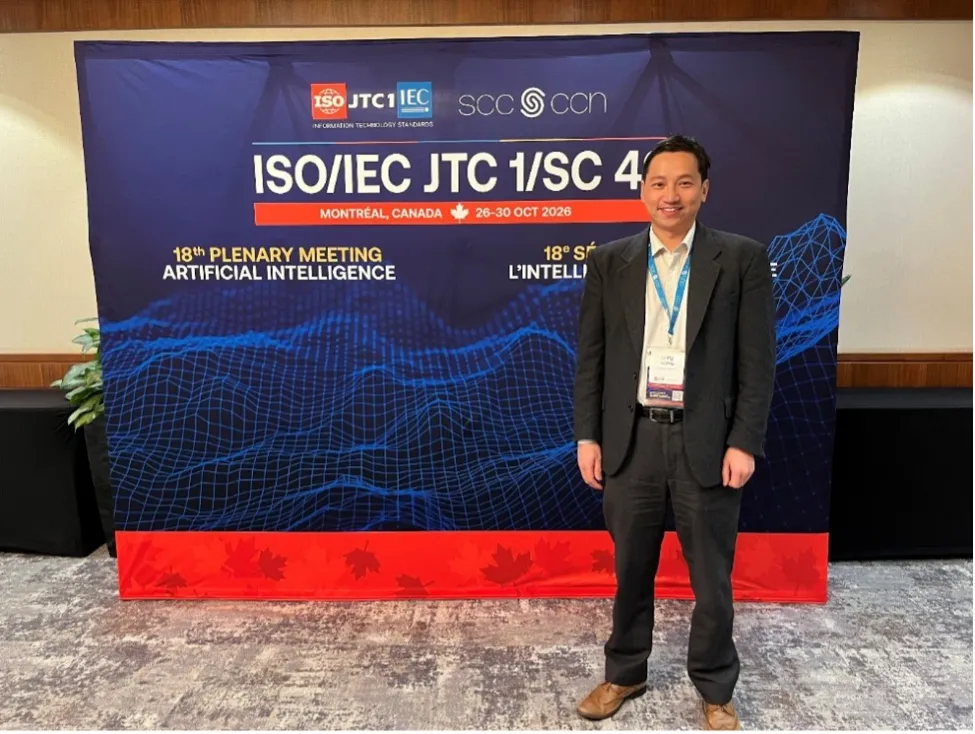
Exponent consultants Dustin Burns, Ph.D., PStat®, and Liyu Wang, Ph.D., P.E., UL-CASP, AISP, NCA-GENL, participated as U.S. experts in the Oct. 26 — 30 ISO/IEC JTC 1/SC 42 plenary in Montréal, Canada, joining experts from around the world working to advance international standards for AI.
Hosted by the Standards Council of Canada, the plenary brought together more than 200 delegates from over 50 countries. ISO/IEC JTC 1/SC 42 is the international technical committee responsible for AI standardization, addressing topics including data, trustworthiness, use cases, testing, functional safety, health informatics, natural language processing, and conformity assessment.
Exponent's participation built on its involvement in U.S. and international standards development. At the Montréal plenary, Dr. Burns, Exponent's lead representative, contributed through SC 42 Working Group 2 on Data, which addresses topics including data quality for machine learning, synthetic data, and the AI data lifecycle.
Dr. Wang participated as a U.S. expert in SC 42 Joint Working Group 4 on functional safety and AI systems, contributing to work on ISO/IEC CD 22440 series and ISO CD 25223. The emerging ISO/IEC CD 22440 series address requirements and guidance for AI considerations on functional safety, with work encompassing areas such as risk assessment and hazard analysis, transparency and explainability, and validation and verification. ISO CD 25223 addresses requirements and guidance on uncertainty quantification of AI systems, which could have a foundational impact on a wide range of domains and applications. Dr. Wang also remains involved in international robotics standards development through ISO TC 299, bringing experience across emerging AI and robotics safety standards.
"I've been blown away by recent advances in AI, particularly its application to formal mathematics," said Dr. Burns. "They've made me simultaneously more excited about what AI can achieve and more conscious of the challenges around safety and trust. That makes the work of AI standardization especially important right now, from establishing clear, consensus-based definitions to bringing international experts together to work through critical technical issues."
"Industry demand for AI safety guidance applies to safety-related systems, non-safety-related systems, and offline generative AI tools used for development of those systems," added Dr. Wang. "The ISO 22440 series builds on ISO TR 5469:2024 to provide application-agnostic frameworks and testing requirements for AI considerations beyond traditional hardware or software functional safety. Meanwhile, ISO 25223 fills a crucial gap by providing requirements and guidance on input data and AI model uncertainty quantification across many industries."
Connecting AI standards to real-world implementation
As organizations rapidly integrate AI into products, operations, and decision-making, international standards provide a common framework for how systems are developed, evaluated, governed, and trusted. SC 42's work spans topics that will inform AI policy, regulation, procurement, and conformity assessment across industries and jurisdictions.
Direct participation in international standards development gives Exponent's experts firsthand insight into emerging approaches to AI data quality, risk, testing, assurance, governance, and functional safety. By participating directly in standards development, we gain deep insight into regulatory intent and implementation. This positions Exponent to help clients proactively navigate technical challenges and ensure their products and processes align with future AI requirements.
Exponent's participation in the Montréal plenary reflects our continued engagement with the technical standards community as organizations navigate the opportunities, risks, and evolving expectations surrounding AI.
Insights