OUR PEOPLE
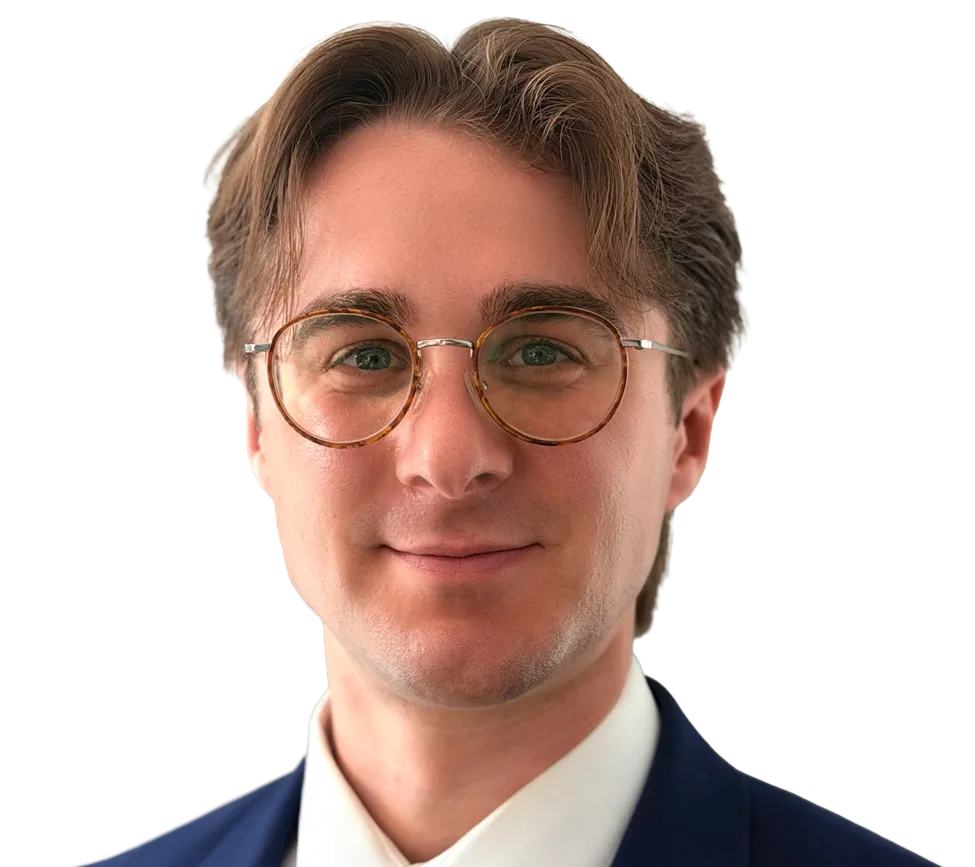
Tymon Nieduzak
Ph.D.
Scientist
Tymon Nieduzak, Ph.D., has developed his expertise in data science and engineering mechanics and is specializing in battery safety, structural health monitoring, applied machine learning, and finite element modeling for complex engineered systems. He helps clients in the automotive, aerospace, energy storage, and civil infrastructure sectors assess risk, investigate failures, and evaluate system reliability by combining experimental and computational methods across advanced sensing, experimental mechanics, and data analytics. His work enables clients to understand complex technical challenges, make informed engineering decisions, and evaluate the performance and reliability of a wide range of products and infrastructure.
Areas of expertise include:
Industries Served
Dr. Nieduzak helps clients transform sensor measurements, laboratory observations, and engineering data into clear, defensible findings that support product evaluation, risk assessment, reliability analysis, technical due diligence, and failure investigations. His approach combines test planning, instrumentation, data analytics, engineering modeling, and machine learning to evaluate system behavior and identify potential performance or safety concerns. He applies these capabilities to product development, condition monitoring, experimental validation, and investigations that require distinguishing normal variability from emerging damage or abnormal system behavior.
For battery and energy-storage systems, Dr. Nieduzak develops sensing, monitoring, and data-analysis approaches that help identify early indicators of battery degradation, abnormal behavior, and fire risk. He integrates information from multiple sensing technologies to evaluate battery condition and assess thermal, chemical, and structural response. His work includes transformer-based autoencoders for battery anomaly detection, finite element heat-transfer modeling, and experimental validation of monitoring strategies and safety-critical systems. This experience supports battery safety evaluations, thermal runaway investigations, monitoring-strategy development, sensor selection, reliability assessments, and the evaluation of emerging battery technologies.
Dr. Nieduzak also evaluates how loading, fatigue, temperature, damage, and manufacturing processes influence the performance and reliability of structures and materials. His work encompasses multifunctional fiber-reinforced polymer composites, embedded sensing technologies, impact and fatigue testing, full-field deformation measurements, and damage detection. He combines conventional instrumentation with computer vision, three-dimensional digital image correlation, optical motion magnification, vibration testing, and modal analysis to assess structural condition across laboratory, component, and field environments. These methods help clients evaluate structural integrity, identify potential failure mechanisms, prioritize maintenance decisions, and assess long-term reliability.
His data-analysis experience includes time-series analysis, sensor fusion, anomaly detection, classical machine learning, deep learning, and computer vision using Python, MATLAB, Java, and C++. He has developed and applied machine learning models, including long short-term memory (LSTM) and transformer architectures, for engineering data analysis, predictive modeling, and pattern recognition. He applies these techniques to identify emerging risks, evaluate asset performance, detect anomalies, and extract actionable insights from complex engineering datasets. Throughout his work, he emphasizes traceable assumptions, data quality, experimental validation, and physical interpretation to ensure that analytical findings remain clear, defensible, and relevant to engineering decision-making.
Before joining Exponent, Dr. Nieduzak conducted research on intelligent composite systems, battery monitoring, wind-energy infrastructure, optical diagnostics, and plasma-processing technologies across both Columbia University and the University of Massachusetts, Lowell. He collaborated on multidisciplinary academic, industrial, and government-sponsored programs and helped advance sensing, monitoring, and predictive-analysis capabilities for a variety of engineering applications. He has mentored and instructed undergraduate and graduate researchers and communicated technical findings through peer-reviewed publications, technical conferences, program reviews, and industry-facing presentations. He has served and continues to serve in instructional and research appointments at Columbia University, most recently as a Professional Instructional Assistant and lecturer.