November 12, 2026
Author




Modeling electrostatic induction beneath overhead transmission lines requires estimating how the lines affect electrical charge distribution across large, irregular terrain corridors. These calculations support electric-field, contact-voltage, and ignition analyses, but traditional simulations can require significant computational time and resources to deploy at scale.
For utilities, a faster approach could make it practical to evaluate more terrain, operating conditions, and network scenarios, supporting efficient risk assessments, infrastructure planning, and system-wide decision-making. It could also advance transmission-line digital twins that help engineers understand how power systems may perform across complex real-world environments.
In their paper "Train on the Sphere, Deploy on the Hill: Closed-Form-Anchored Surrogates for Real-Terrain Boundary-Integral Equations," forthcoming in the December 2026 Neural Information Processing Systems (NeurIPS) conference proceedings, Exponent's Stephane Zsoldos, Therice Morris, Ben Wetherfield, and Varundev Sukhil present a physics-informed ML approach that combines canonical closed-form solutions with sparse, high-fidelity boundary-element data for realistic terrain. NeurIPS is the leading global conference for AI and ML. The team's method starts from a local tangent-plane baseline and learns a small neural correction using dimensionless geometric and source-field features, while keeping the underlying analytic kernel fixed, grounding the model in established physical laws rather than data alone.
In testing, the model closely reproduced established physics and remained accurate even when electrical inputs varied across an exceptionally wide range — conditions that caused several larger AI approaches to break down. It is validated on traditional simulation results on both synthetic curved surfaces and previously unseen transmission-line corridors. The resulting model — just a few kilobytes in size — runs in seconds on an ordinary computer, making sophisticated ground-charge calculations more practical across large utility networks.
For industry, that speed could help teams compare scenarios earlier, focus detailed engineering resources where they matter most, and make better-informed decisions about safety, planning, and system performance. More broadly, the work shows how combining ML with proven scientific and engineering principles can produce faster, more reliable tools for solving complex real-world problems.
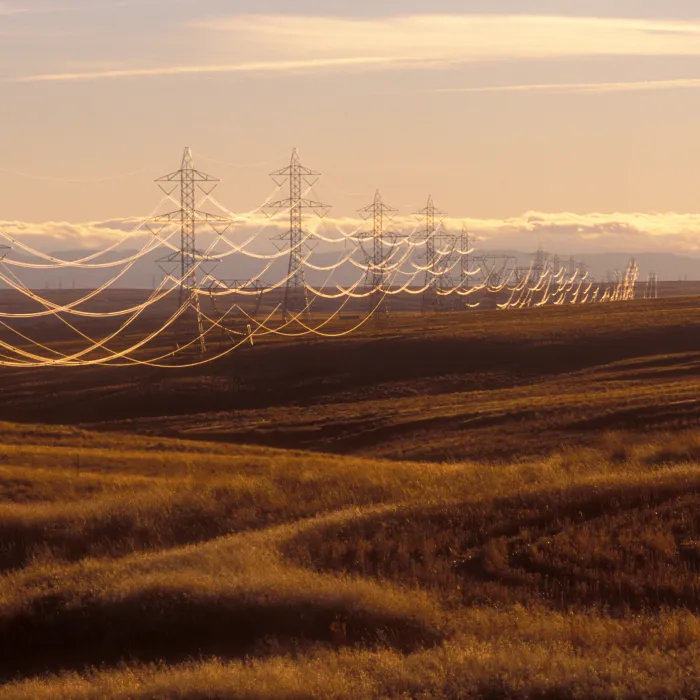
"Train on the Sphere, Deploy on the Hill: Closed-Form-Anchored Surrogates for Real-Terrain Boundary-Integral Equations"
Read the full article here
From the publication: "On seven industrial transmission- line corridors with native triangulated meshes, the extended recipe attains 9.2% median relative RMS against dense BEM on the held-out corridors, 20x tighter than the analytic plug-in."
Insights