OUR PEOPLE
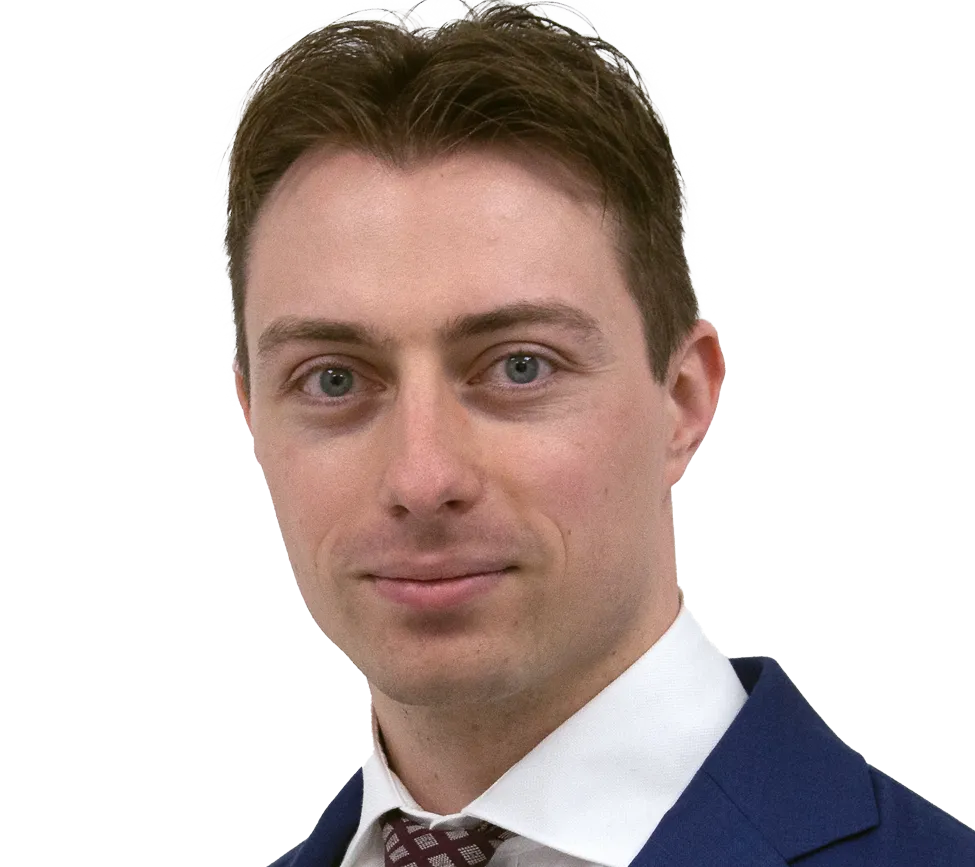
Dr. Truttmann specializes in materials science, chemistry, and inferential statistics applied to technical innovation, reliability, and failure analysis. He combines microscopic insights from materials characterization with macroscopic insights from inferential statistics to identify the small features, dilute concentrations, and rare events that explain how products function and how they fail.
Electron Microscopy
Dr. Truttmann is an operator of Exponent's scanning electron microscopes (SEMs) and plasma focused ion beam (PFIB) in Menlo Park. He often uses the high resolution of SEM and elemental identification from energy-dispersive spectroscopy (EDS) to quickly discern products' structure and composition for intellectual property. Dr. Truttmann also uses SEM for fractography to determine the defects and stress conditions that lead to fracture in glasses, single crystals, and metals.
Dr. Truttmann uses FIBs to remove material in controlled patterns to "peer under the surface" of products, creating cross sections that can be imaged in situ to measure the thicknesses of coatings or the stackup of layered materials, and to prepare lamellae for transmission electron microscopy (TEM). Dr. Truttmann can also perform electron backscatter diffraction (EBSD) and transmission Kikuchi diffraction (TKD) to directly measure grain orientation and microstructure of polycrystalline solids.
Inferential Statistics & Reliability
Dr. Truttmann has applied inferential statistics to reliability and failure analysis, where data is often highly censored and questions are frequently open-ended. Dr. Truttmann uses a broad set of tools to address these challenges, and may use frequentist, Bayesian, multivariate, or heuristic approaches where appropriate. These tools have supported projects ranging from lithium-ion battery fire forecasting in electric vehicles to limiting the scope of consumer-product safety recalls by making sense of loosely correlated attribute data. In these projects, Dr. Truttmann emphasizes combining multiple information sources into comprehensible visualizations that accurately convey uncertainty and directly answer client questions.
Computer Vision & Artificial Intelligence
Dr. Truttmann has experience in computer vision analyzing SEM and X-ray images. With Python packages like scikit-image or OpenCV, he commonly applies image segmentation to extract particle size distributions from images. Dr. Truttmann also uses deep learning to make sense of large image data sets, using tools like Pytorch to create neural networks that learn feature correlations between images (or between images and other measurements). He also uses model interpretability tools like Captum to uncover and visualize these correlations. To generate the large image datasets necessary for meaningful deep learning, Dr. Truttmann has designed and implemented high-throughput automated data acquisition and processing pipelines. Dr. Truttmann is an operator of Exponent's 2D X-ray system in Menlo Park, with which he has experience programing for automated image acquisition.
Intellectual Property
Dr. Truttmann has assisted clients in disparate intellectual property matters helping evaluate patent validity and product infringement for both plaintiffs and defendants. Dr. Truttmann has assisted clients in district court litigation, International Trade Commission (ITC) investigations, inter partes reviews (IPR), and ex parte reexaminations (EPR). Dr. Truttmann has applied this broad technical knowledge to IP projects involving lithium-ion batteries, solar cells, and recyclable packaging.
Semiconductor Growth, Characterization, & Device Fabrication
Dr. Truttmann received his Ph.D. from the University of Minnesota in 2023. During his Ph.D. research, Dr. Truttmann studied ultra-wide-bandgap semiconductors, materials with bandgaps exceeding 4 eV, making them transparent to visible light and capable of handling high voltages. His research included their growth, characterization, and use in transistors.
A large part of his research was dedicated to studying how deposition techniques and growth conditions can be tailored to a specific material and application. In particular, his research utilized hybrid molecular beam epitaxy (MBE), a high-vacuum vapor deposition technique sometimes described as a combination of traditional MBE and chemical vapor deposition (CVD). His research included the design and construction of two MBE systems customized with metal-organic precursor sources, oxygen plasma, in-situ electron diffraction, and an electron beam evaporator.
His choice of growth conditions was informed by his own materials characterization, which gave him hands-on experience in reflection high-energy electron diffraction (RHEED), high-resolution X-ray diffraction (XRD), atomic force microscopy (AFM), X-ray photoelectron spectroscopy (XPS), and van der Pauw Hall electron mobility measurements. His XRD work included the full suite of techniques required to evaluate thin-film epitaxy, thickness, and strain including specular coupled scans, rocking curves, azimuthal scans, reciprocal space maps (2D and 3D), pole figures, and reflectivity. Dr. Truttmann also received hands-on experience in the cleanroom fabricating transistors.
At Exponent, Dr. Truttmann continues to apply his knowledge of semiconductors and devices to address client needs. Dr. Truttmann has conducted technical due diligence for venture capital investments in hard-tech startups, and performed failure analysis on consumer electronics displays.