June 30, 2025
Authors


Updated September 2026
This article has been updated to reflect additional product recall data released since its original publication, as well as recent developments in the CPSC injury surveillance capabilities.
What are the benefits of incorporating human factors principles across the consumer product lifecycle?
In 2020, the U.S. Consumer Product Safety Commission (CPSC) and Health Canada's Consumer and Hazardous Products Safety Directorate (Health Canada) published Guidance on the Application of Human Factors to Consumer Products, stating, "Many product-related injuries can be prevented by better design. Providing the consumer product industry with suggestions on how to apply human factors principles to their products can help lower the number of product-related adverse incidents and reduce costly compliance and enforcement actions."
More than five years later, the guidance remains highly relevant as product recalls and safety warnings continue to increase. This increase is evident across both long-term and current year data:
- Annual Growth: Total yearly recalls nearly doubled over a four-year span, increasing from 219 in 2021 to 422 in 2025.
- Current Year Increase: The pace is accelerating. Through August 2026, the CPSC had already issued 412 recalls and warnings. This is a sharp increase from 277 during the same period last year, and a 148% increase compared to the 166 issued during the same period in 2020 when the guidance was released.
At the same time, CPSC is expanding its ability to identify emerging product safety concerns. In 2026, the agency announced a modernization of the National Electronic Injury Surveillance System (NEISS), one of its primary tools for monitoring consumer product-related injuries and identifying potential safety concerns. The updated system expands participation from 36 states to all 50 states, and it's designed to make the database "more timely, more accurate, and more cost-effective," resulting in "stronger consumer product oversight" through "earlier detection" followed by "earlier warnings, recalls, and protective actions" by CPSC to manufacturers.
The modernization is also expected to incorporate more advanced analytical tools to support identification of "rare and rapidly emerging" injury patterns and potential hazards. As regulators gain greater visibility into product-related injury trends and potential safety concerns, manufacturers may face increasing pressure to identify use-related risks earlier in the product lifecycle.
Human factors evaluations can and do play a huge role in a product's safety and effectiveness in the market. CPSC does not report on any associations between product recalls and specific testing or guidance that was missed; however, the agency's recall announcements routinely involve products across a wide range of categories, including children's products and toys, exercise equipment, electronics, household goods, and products intended for older adults, with many involving issues related to design, use, warnings, or what the CPSC terms "foreseeable" misuse.
Despite the CPSC and Health Canada guidance being released more than five years ago, many manufacturers may still be unfamiliar with the nuances of applying it to their products. Many designs that were in ideation or development when the guidance was published are only now generating years of postmarket surveillance data, consumer reviews, and field experience. This means stakeholders ranging from product designers and engineers to executives, quality professionals, and legal teams are increasingly grappling with what CPSC and Health Canada's recommendations mean in the context of real-world human factors strategies and potential recalls.
Manufacturers also face uncertainty regarding how product safety risks will be identified and evaluated in the years ahead. The CPSC and Health Canada guidance shares similarities with human factors requirements from agencies such as the Food and Drug Administration, the Federal Aviation Administration, and the European Medicines Agency, as well as international standards organizations such as the International Organization for Standardization (ISO). Unlike those heavily regulated sectors, however, consumer product manufacturers often operate in areas with limited formal premarket regulatory oversight. Product testing approaches can vary widely, and manufacturers are largely responsible for determining what type and depth of testing is appropriate for their products and users.
Approaches that combine behavioral science, engineering analysis, and product-specific expertise can provide a more robust understanding of how users interact with products and where potential risks may emerge.
As one example, an Exponent client conducted numerous premarket safety tests on a product with an integrated blade but did not consider intentionally evaluating incorrect product use to identify specific risks associated with injury and develop mitigation strategies. Drawing on the principles reflected in the CPSC and Health Canada guidance, Exponent recommended additional testing focused on potential misuse scenarios. The resulting evaluation framework strengthened the overall safety assessment and helped reduce the risk of future product safety concerns associated with unanticipated product use.
In the event of a recall, regulatory inquiry, or injury claim, product developers may need to demonstrate how they evaluated risk and addressed potential hazards. Human factors evaluations provide multiple benefits, including helping manufacturers identify opportunities for safety improvement, strengthen product development processes, and optimize user experiences. A key challenge is translating broad regulatory recommendations into practical actions and implementing those actions at meaningful points throughout the product lifecycle.
The CPSC and Health Canada guidance framework
For consumer product manufacturers, determining when human factors evaluations should be incorporated into development is an important consideration affecting go-to-market planning, costs, and overall strategy. When evaluations are conducted without consideration of the broader product lifecycle, the impacts can be significant. For example, conducting user testing after major production decisions have already been made may result in redesigns, discarded inventory, manufacturing changes, project delays, or even cancellation of a product if significant safety concerns are identified.
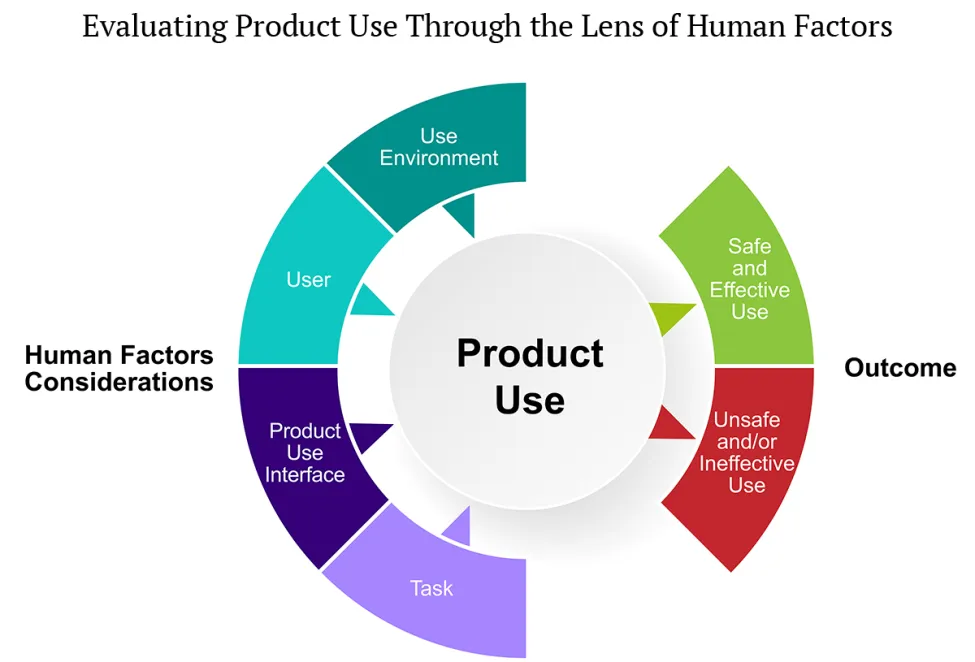
For this reason, the guidance emphasizes implementing human factors evaluations early through preliminary analyses to identify:
- Product users
- Critical user tasks
- The use environment
- Interactions between users and product design
In addition to determining when to perform evaluations, manufacturers must decide what to evaluate and how to evaluate it. The guidance emphasizes the importance of assessing hazards associated with "unintended-but-foreseeable" use and users. This includes circumstances where consumers interact with products in ways the manufacturer did not intend but that can reasonably be expected to occur, as well as situations where products are used by individuals outside the intended user population.
As a starting point, the guidance identifies several factors manufacturers should consider when evaluating "unintended-but-foreseeable" use scenarios, including:
- Product demands that exceed users' physical, perceptual, or cognitive capabilities
- Product functionality that does not align with user expectations
- Environmental conditions that affect safe product use
Even with these considerations, human behavior remains difficult to predict. Real-world product use is influenced by a wide range of circumstances, experiences, expectations, and environmental factors. The guidance presents frameworks to help manufacturers think critically about how human characteristics, capabilities, and limitations may influence product interactions across diverse user populations and use environments.
For example, Exponent worked with an automotive manufacturer to evaluate how children could potentially access batteries inside a key fob design. Leveraging historical knowledge of the product category and established human factors methodologies, Exponent developed an evaluation approach focused on child interaction with the product. The assessment provided insights into design vulnerabilities and opportunities to reduce risk.
When potential use concerns are identified, manufacturers may benefit from evaluating or testing a product — a process referred to by the CPSC and Health Canada as a "foreseeable-use analysis" — across critical tasks, frequent and infrequent use scenarios, and diverse user populations. Multiple test sessions and repeated evaluations may also help reduce bias and improve understanding of user behavior.
One common consideration is how physical capabilities change across age groups. A design feature intended to protect children may inadvertently create usability challenges for older adults. Likewise, age-related changes in visual or auditory perception can influence the effectiveness of alarms, instructions, displays, labels, and other feedback mechanisms. When incorporated early in development, findings from these evaluations can inform product functionality, user population definitions, warnings, instructions, and risk control measures.
Beyond testing, methods for identifying unintended use scenarios can include reviewing historical and public data sources involving the product or similar products, including consumer complaints, product reviews, recalls, incident reports, injury databases, and other postmarket information. As injury surveillance systems continue to expand and provide broader visibility into consumer product-related incidents, these sources may offer increasingly valuable insight into emerging hazard patterns, use environments, and unanticipated misuse scenarios that can inform product design, warnings, postmarket surveillance activities, and other risk mitigation efforts.
These considerations are often implemented proactively during development but can also provide valuable insight for companies responding to safety concerns, regulatory inquiries, incident investigations, or alleged product failures.
Human factors and real-world implementation
A primary goal of incorporating human factors evaluations is to support safe and effective product use without serious use errors or problems. Once reasonably expected product uses have been identified, a thorough risk assessment can help determine, prioritize, and mitigate potential use-related hazards.
Risk assessments are often most useful when they go beyond abstract ratings and incorporate meaningful technical analysis. Approaches that combine behavioral science, engineering analysis, and product-specific expertise can provide a more robust understanding of how users interact with products and where potential risks may emerge.
The value of a multidisciplinary approach extends beyond individual investigations. By integrating human factors expertise with engineering, materials science, biomechanics, data analysis, and other technical disciplines, manufacturers can gain a more complete understanding of how product design, user behavior, and environmental conditions interact to influence safety outcomes.
Connecting the total product lifecycle
Human behavior is variable and context-dependent, making it difficult to predict completely. As a result, even products developed with safety in mind can encounter unforeseen challenges after launch. Recalls, safety warnings, and consumer complaints can carry substantial financial, operational, legal, and reputational consequences.
To support safety and effectiveness once products reach the market, post-production reviews and postmarket surveillance can be valuable tools for identifying emerging concerns before they escalate. This includes monitoring use by unintended user groups, use in unexpected environments, evolving consumer behaviors, and patterns observed in complaints, incident reports, and injury data.
As product safety guidance, injury surveillance systems, and regulatory tools continue to evolve, manufacturers may have access to more information than ever before about how products perform in real-world settings. Organizations that connect human factors evaluations with ongoing postmarket surveillance efforts may be better positioned to identify emerging risks, respond to consumer insights, and address potential safety concerns before they result in recalls or regulatory scrutiny.
By integrating human factors evaluations throughout the product lifecycle, from assessing early concepts and refining existing designs to conducting usability studies and supporting recall-response efforts, manufacturers can uncover potential use-related issues before they become costly problems. A user-centered perspective not only enhances usability but can also improve product safety outcomes and strengthen risk management efforts.
When applied effectively, human factors insights can improve product safety, support regulatory objectives, and contribute to more successful product development programs. Yet integration is not always straightforward. Organizations may also need to navigate limited timelines, changing user expectations, complex use environments, business constraints, and competing priorities. Addressing these challenges early and consistently can help organizations build safer, more effective products while reducing the likelihood of costly problems later in the product lifecycle.

What Can We Help You Solve?
Exponent's engineers and scientists have extensive experience evaluating hazards associated with the use and misuse of a wide array of products. We leverage publicly available data, scientific literature, regulatory knowledge, and domain expertise to identify hazard patterns and develop and conduct tests with volunteers and anthropomorphic test devices to assess product usage and injury potential.

Consumer Product Design, Usage & Injury Analysis
Expert user interaction analysis to support mitigating the risk of injuries from consumer products.
Improve User Research & Testing
Human factors investigations for data-driven product and process design decisions.
Consumer Product Design & Safety
Human factors and risk analyses to help clients improve designs for a range of products.

Child Safety
Understand the impact of various products on child safety with expert human factors analyses.
User Research Testing & Evaluations
Pioneering scientific user experience research across the full lifecycle of consumer, industrial, automotive, and medical device products.