February 20, 2026
Author

The accumulation of firebrands — embers typically generated from burning vegetation or structural components that can blow away from a fire in progress — is a primary driver of structure loss during wildland-urban interface (WUI) fires. However, most research has focused on small-scale ignition testing of materials when exposed to a single or small group of firebrands. These tests don't fully capture the large-scale construction and atmospheric effects surrounding hot embers collected in piles on building features like decking materials.
In a study published by Applications in Energy and Combustion Science, Exponent's Jacques De Beer and co-authors present a large-scale experimental methodology used to evaluate the ignition propensity of decking assemblies exposed to controlled firebrand piles under wind, closely replicating conditions observed in real WUI fires.
In their evaluation, the authors used 60 × 60 cm decking assemblies to examine the thermal response of pressure-treated wood (PTW) and wood-polymer composite decking (Trex) under sustained exposure to piles of glowing firebrands. Decking assemblies were subjected to constant laminar wind speeds of 1.4 m/s and 2.7 m/s (approximately 3 to 6 mph) under realistic material moisture conditions (PTW at 26% and 7% moisture content; Trex <1%). Unlike bench-scale radiant tests, this configuration produced non-uniform, transient heat flux coupled with airflow, enabling observation of ignition and damage mechanisms not previously documented at a larger scale.
Across all pressure-treated wood experiments, the authors found that wind speed was the dominant driver of ignition and damage severity. Increasing wind from 1.4 to 2.7 m/s (3 to 6 mph) sharply raised burn-through likelihood, shortened time to structural integrity failure, and resulted in sustained back-surface flaming and re-ignition. Lower material moisture content further increased ignition propensity by reducing heat losses to moisture evaporation and accelerating combustion. The orientation of firebrand piles relative to the wind was noted to play a secondary role: perpendicular piles increased early burn-through, while parallel piles led to earlier, longer, and more frequent back-surface flaming after openings formed.
Overall, the results show that deck ignition vulnerability is highly sensitive to realistic environmental conditions, particularly wind and material moisture, and that firebrand piles can trigger damage modes not captured by standard flammability tests. These findings highlight the value of product-scale evaluations under atmospherically realistic conditions to inform fire-resistant design, materials selection, and WUI fire mitigation strategies.
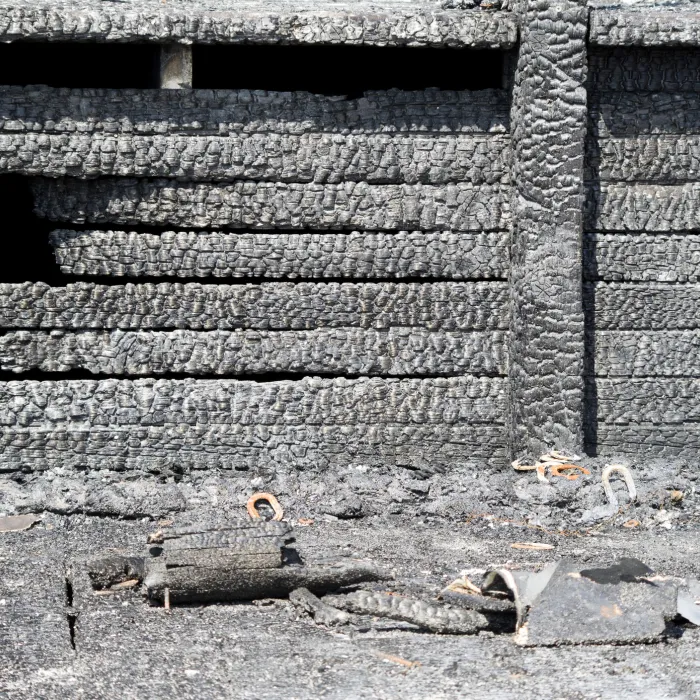
"Evaluating the Thermal Response of Large-Scale Decking Assemblies Exposed to Firebrand Piles"
Read the full article here
From the publication: "Wind speed emerged as the dominant factor in each of the events characterized in these experiments … greatly impacting the occurrence and time to documented events."