
March 27, 2026
Authors

Knee osteoarthritis (OA) places a substantial burden on patients and healthcare systems, leading to pain, functional limitation, and frequent clinical visits. Payers and providers are increasingly evaluating nonoperative options based on near-term healthcare resource utilization and cost — particularly for commonly used intra-articular treatments such as hyaluronic acid (HA) and intra-articular corticosteroids (ICS). Understanding how different HA products perform in real-world practice is important because HA preparations vary in molecular weight and other properties that may translate into meaningful differences in both outcomes and downstream resource utilization.
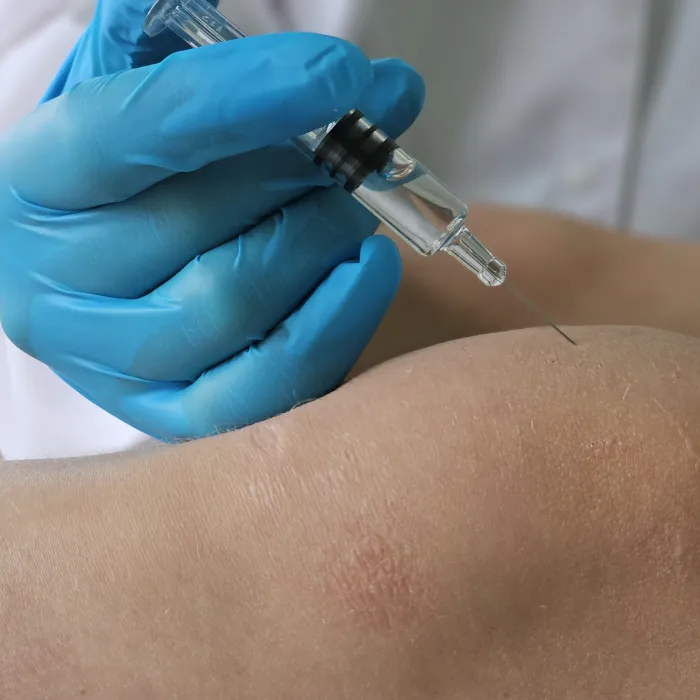
In a Journal of Medical Economics article, "Economic value of intra-articular knee OA therapies: a U.S. perspective," Exponent's Heather Watson and Kevin Ong conducted a retrospective cohort analysis using Optum's de-identified Clinformatics claims database to compare six-month medical/pharmacy costs and healthcare resource utilization among patients receiving HA or ICS therapy.
The study categorized HA products by molecular weight — high (HMW), medium (MMW), and low (LMW) — and matched approximately 6,200 patients per group. The rheologic properties of HMW HA products have been reported to be more consistent with those of healthy human HA, whereas LMW HA products have properties similar to saline. There also appears to be molecular-weight dependent anti-inflammatory effects, with higher molecular weight HA suppressing the expression of pro-inflammatory responses.
Among HA formulations, costs and utilization both favored higher-molecular-weight products: adjusted medical costs were highest for LMW HA ($527 per patient per month), followed by HMW HA ($469) and MMW HA ($442). The six-month rates of office visits, arthrocentesis, and subsequent injections were highest for the LMW HA group and decreased significantly from LMW HA to MMW HA to HMW HA (p < .001 between all groups). Although ICS had the lowest overall adjusted medical costs ($240 per patient per month), ICS patients required more additional pain management — with higher rates of new prescription analgesic use (15.8% vs. 11.7 — 12.2% for HA groups) and notably higher rates of adjunctive injections, both repeat ICS (21.8% versus 9.4 — 11.1% for HA groups) and subsequent HA (14.1% versus 1.6 — 5.3% for HA groups). Complication rates were low across all groups, consistent with the established safety profiles of both treatment classes.
These findings suggest that, among HA options, HMW formulations may offer greater short-term clinical and economic benefits. They also suggest that while ICS may appear least costly on the surface, the greater downstream need for additional treatments tells a more complicated story — one with relevance for coverage decisions, treatment guidelines, and individualized nonoperative care planning, particularly in light of emerging evidence raising concerns about long-term cartilage effects with repeated corticosteroid use.
"Economic value of intra-articular knee OA therapies: a U.S. perspective"
Read the full article here
From the publication: "This retrospective cohort study of knee OA patients undergoing intra-articular HA or CS injections suggests that, among HA products, high molecular weight HA may provide greater short-term clinical and economic benefits."
