
June 4, 2026
Authors





Executive Summary
State lawmakers across the country are increasing scrutiny of per- and polyfluoroalkyl substances (PFAS) in biosolids. In the absence of federal standards, states are pursuing a range of approaches, including monitoring, reporting, and even restricting land application of biosolids that contain PFAS. For biosolids generators and managers, evolving state requirements may affect sampling strategies, data interpretation, stakeholder communications, and long-term planning and management. As policy and research continue to evolve, proactive, science-based planning can help organizations adapt to changing expectations.
How is PFAS as an emerging contaminant shaping policy, liability, and management strategies?
Per- and polyfluoroalkyl substances (PFAS) are used in a wide variety of products that are extensively distributed in commercial markets. Due to their chemical stability and limited effective treatment methods, PFAS can persist in the environment and accumulate over time. In sanitary and industrial sewer systems, these substances may leach from consumer products or be released during manufacturing processes, which can eventually reach municipal and industrial treatment plants.
Municipal wastewater treatment plants receive various waste streams from industrial, commercial, and residential sources that may contain PFAS at varying concentrations, which can then accumulate in biosolids (i.e., solids derived from wastewater treatment). Biosolids are valued as a sustainable material rich in nutrients and organic matter that benefits soil systems. They are commonly applied to agricultural fields as soil amendments and are less often burned or diverted to landfills. However, elevated PFAS concentrations in biosolids have raised concerns about their impacts to ecosystem health and potential human exposure resulting from common land-application practices.
State-led regulation accelerates ahead of federal standards
There are currently no federally enforceable PFAS standards for biosolids. Although the Environmental Protection Agency (EPA) has developed a draft risk assessment, it has not been finalized for regulatory use. EPA has established an analytical method for PFAS analysis in biosolids (Method 1633), which is used as an analytical method for regulatory compliance. This is distinct from the EPA's draft risk assessment, which evaluates potential exposures rather than measurement approaches. Method 1633 is tailored towards a small subset of 40 compounds, compared to the much broader range of compounds classified as PFAS.
The presence of PFAS in biosolids and their associated land applications is coming under increased scrutiny from legislators across the U.S. Currently, Maine and Connecticut have effectively banned the land application of all biosolids. Eight additional states (California, Colorado, Massachusetts, Maryland, Michigan, Minnesota, New Hampshire, and Vermont) have policies requiring PFAS monitoring in wastewater treatment plant influent, effluent, and/or biosolids.
Together, these developments reflect a fragmented and evolving regulatory landscape, with implications for biosolids management, permitting, and long-term planning.
In 2025, two states, Rhode Island and Washington, passed laws requiring biosolid-generating facilities to routinely sample for and report PFAS concentrations. Other states, such as Massachusetts, New York, and Oklahoma, have proposed a ban on the use of biosolids or biosolids-derived fertilizers for land application altogether. Over the course of the 2025-2026 legislative sessions to date, several states have proposed at least one bill to monitor and/or manage PFAS concentrations in wastewater and/ or biosolids. Examples include:
- Kansas' HB 2682 proposed regulating land application of biosolids with an exception for farmers using biosolids on their own land. Legislation failed to pass.
- Oklahoma's SB2141 proposes a tiered approach to managing the land application of biosolids based on the concentration of detected PFAS.
- Iowa's SF2193 would require testing of wastewater facilities for PFAS and written notice to farmers who intend to use the biosolids on their lands.
Together, these developments reflect a fragmented and evolving regulatory landscape, with implications for biosolids management, permitting, and long-term planning.
In the absence of finalized federal standards, states are continuing to define their own regulatory approaches to PFAS in biosolids, including monitoring, reporting, and restricting land application of biosolids. See Table 1 for details, current as of the date of this publication.
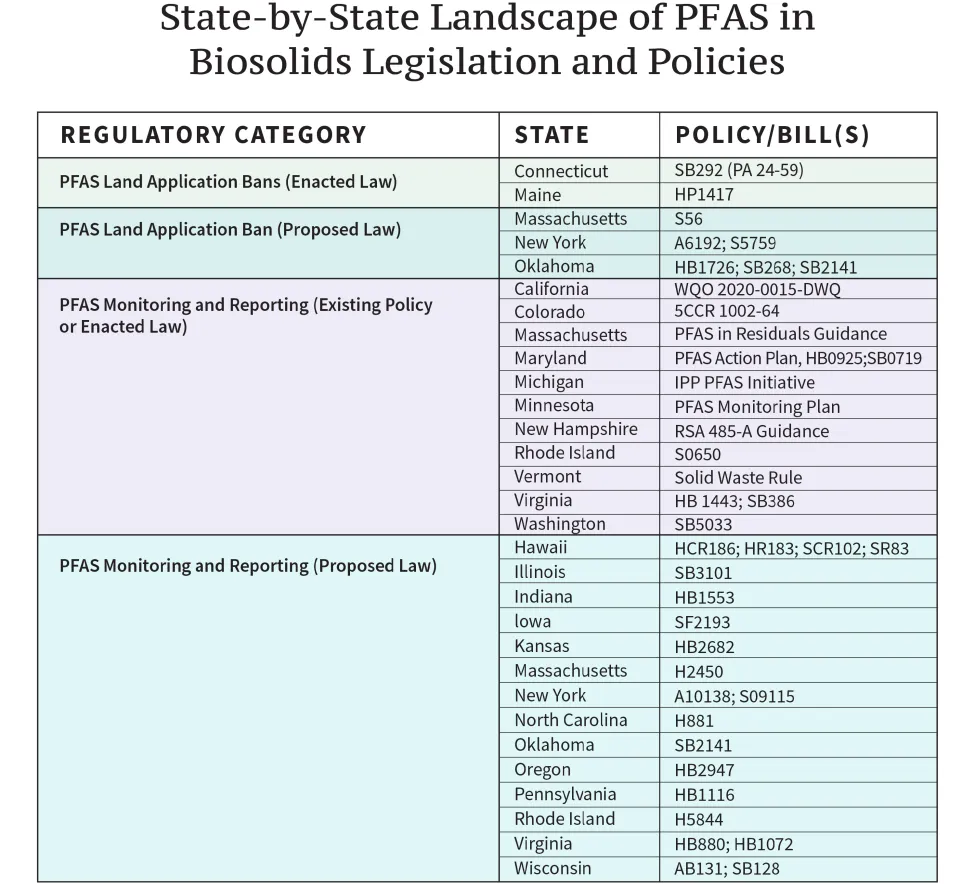
Table 1: State-by-state overview of recently enacted and proposed PFAS biosolids regulations.
Please note: this table is only current as of the date of this publication, June 1, 2026.
For updates, please contact the authors or follow links to each listed legislation here
As states increase efforts to manage and monitor PFAS in biosolids, numerous suits have been filed against biosolids producers and their affiliates for contamination and liability related to PFAS exposure. Recently, a federal court ruled that biosolids pellets are a "useful product" and that the New England Fertilizer Company (NEFCO) cannot be considered an "arranger" under the Comprehensive Environmental Response, Compensation, and Liability Act of 1980 (CERCLA) on that theory. Further, Casella, a transporter of biosolids generated by NEFCO, was also found not liable under the analogous Massachusetts Chapter 21E transporter theory because the useful-product defense extended to Casella, and the court dismissed the claims against Casella with prejudice.
While municipalities, transporters, applicators, and farmers using biosolids can and have been subject to lawsuits and state regulations, biosolid management companies are targeted more frequently. Proposed regulations, such as Iowa's SF2193, include litigation protections for farmers who have received and applied PFAS-containing biosolids. However, biosolids management companies currently have not received similar protection in many instances at the state level, despite contamination sources occurring outside biosolids production. As lawsuits, legislation, and court rulings continue to be issued, the US House of Representatives has introduced HR1267, which, if passed, would provide codified protection for these various public and private water and waste treatment facilities and associated entities from liability under the CERCLA.
Looking ahead
Responses to PFAS in biosolids differ significantly among states and between state and federal strategies. Meanwhile, at the state level, clarification on which PFAS are regulated, whether all or specific compounds such as perfluorooctanesulfonic acid (PFOS) or perfluorooctanoic acid (PFOA), is essential for compliance with those regulations. Given the rapidly evolving scientific knowledge and regulatory process, biosolids generators and managers should closely monitor proposed regulations and industry trends to understand how risk continues to evolve at the state and federal levels.
What Clients Are Talking About
What Can We Help You Solve?
Exponent helps clients navigate evolving PFAS regulations in biosolids through science-based strategies. Our multidisciplinary teams provide regulatory tracking, risk assessment, environmental forensics, and fate and transport analysis to support informed decision-making and proactive adaptation as policies and scientific understanding continue to evolve.

Environmental & Regulatory Compliance
Rigorous analyses to help clients overcome complex environmental and regulatory hurdles and meet auditing obligations.

PFAS Consulting Services
Manage PFAS in your products, supply chains, and waste streams.

Emerging Contaminants
Exponent helps clients with chemical regulatory compliance, supply chain assessments, and mitigation and substitution strategies for CECs.

Bioavailability & Chemical Exposure Assessment
Bioavailability analysis for soils, sediments, and natural waters.

Environmental Assessment & Remediation
Conduct timely, accurate site assessment to identify risks and remediation options.

Chemical Compliance
We help clients navigate constantly evolving, global chemical regulatory landscapes and product compliance challenges.
Insights