May 18, 2026
Author

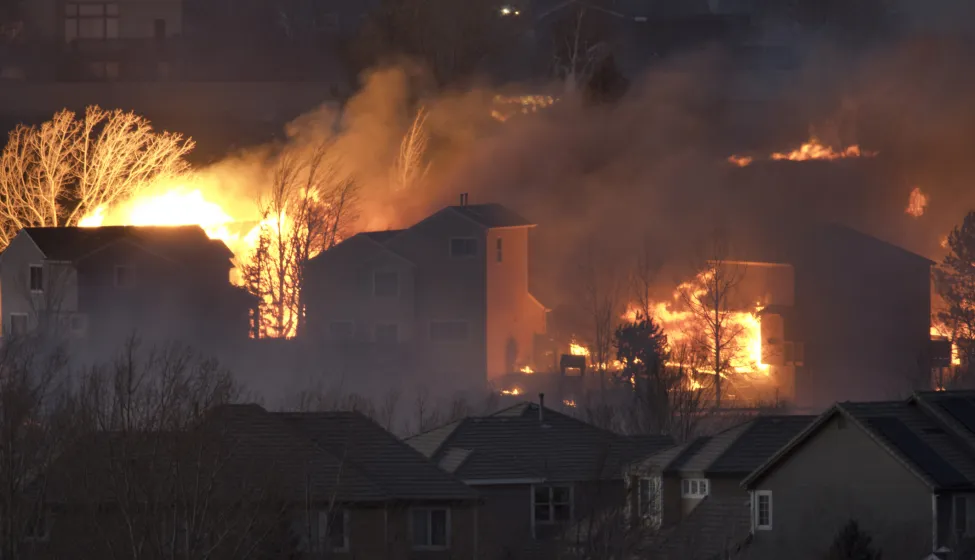
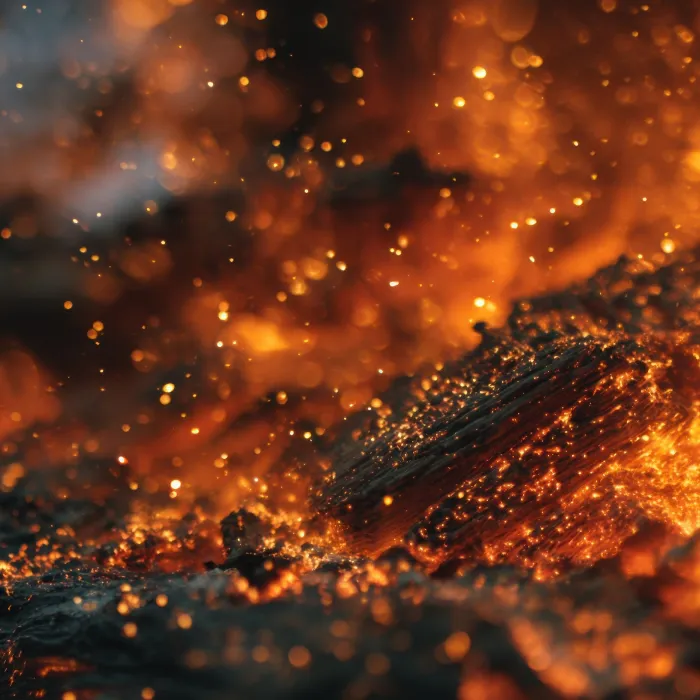
Firebrands — glowing embers generated from burning vegetation or structures — are one of the leading causes of structure ignition during wildland-urban interface (WUI) fires. Carried by wind and wildfire-generated plumes, they can accumulate in piles and ignite construction materials used for decks, siding, roofs, and vents. This ignition mechanism is complex and often challenging to accurately capture with conventional testing.
In the study "A criterion for ignition of combustible solids exposed to firebrand piles," published in Fire Safety Journal, Exponent's Jacques A. De Beer and co-authors Sangkyu Lee, Stanislav I. Stoliarov, and Peter B. Sunderland present a modeling framework to predict ignition of materials exposed to firebrand piles.
The work focuses on preleading zone ignition, where a stable flame was noted to reproducibly form on the surface just in front of a firebrand pile, on the exposed surface facing the wind. This area of the pile experiences high-intensity radiant heat exposure from the embers, making it a critical location for ignition under wind-driven conditions.
Using prior bench-scale wind tunnel experiments, the study evaluates Western Red Cedar, pressure-treated wood, and a wood-plastic composite across a range of airflow velocities and firebrand coverage densities. The model combines an empirical firebrand heat flux approach with detailed pyrolysis modeling to predict heat exposure and ignition propensity near the leading edge of a firebrand pile.
The authors found that a nominal heat flux in the range of 120 kW/m² provides a reliable criterion for predicting preleading zone ignition. The same threshold also predicts ignition timing across materials and testing conditions.
Overall, this work provides a new physics-based approach for evaluating firebrand ignition hazards in WUI fires. By linking firebrand heat feedback, material pyrolysis, and a practical ignition criterion, it provides a framework for assessing how combustible materials may respond to localized ember accumulation under wind.
"A criterion for ignition of combustible solids exposed to firebrand piles"
Read the full article here
From the publication: "The probabilities of ignitions increased significantly with increasing the length of the edge of the pile facing the air flow."