March 31, 2026
Authors


Executive Summary
Battery digital twins for electric vehicles integrate electrical, thermal, operational, and diagnostic data to provide deeper insight into battery performance, safety and long-term health. Combining real‑time telemetry with physics-based models and AI-enabled analytics, digital twins can help manufacturers refine design tradeoffs and develop preventive maintenance strategies that improve fleet reliability. When grounded in multidisciplinary science and engineering expertise, EV battery digital twins have the potential to deliver more accurate predictions and actionable insights — uniting data science with first principles and domain knowledge.
How can digital twins enhance EV battery monitoring, reliability, and predictive maintenance?
Today's electric vehicle battery packs can contain thousands of cells that may exhibit distinct degradation behavior influenced by temperature, charging patterns, road conditions, manufacturing variability, pack architecture, and environmental exposure. Battery management systems (BMSs) continuously collect data to support real-time monitoring and control. The volume, variability, and limited observability of this data can make it difficult to extract longer-term insight into battery aging and performance. As a result, it becomes a challenge for many EV teams to identify performance trends, detect subtle precursors to failure, or contextualize edge cases across an entire fleet.
EV manufacturers are increasingly seeking methods that go beyond advanced monitoring and control to deliver meaningful battery diagnostics, enabling earlier safety and reliability concerns and identifying warranty risks before they manifest as failures in the field. Battery digital twins offer a potential pathway. By leveraging telemetry data, physics-based models, and sound engineering principles, digital twins can support the development of more accurate diagnostics and state estimation models, creating opportunities to improve battery safety, reliability, and lifecycle performance.
Digital twins are typically developed as high-fidelity models used during design, development, and validation, where they can simulate battery behavior under diverse operating conditions. Insights from these models can then be translated into reduced-order or control-oriented models that inform advanced battery management systems (BMSs) deployed in vehicles.
What challenges do traditional BMSs face?
While many BMSs are designed to enforce safe operating limits, they are typically optimized for real-time control using onboard measurements, calibrated thresholds, and embedded estimation logic. These approaches can be challenged by degradation behaviors across different chemistries, usage patterns, and manufacturing variability. As a result, early degradation signals may be difficult to distinguish from normal operating variability, particularly within high-volume data streams or when telemetry is incomplete. For example, real-world telematics data across more than 22,700 EVs reveal an average battery capacity degradation rate of about 2.3% per year, but that rate can double with high-power DC fast-charging, illustrating how use patterns and stressors can challenge fixed threshold approaches to degradation monitoring.
Battery diagnostics in the BMS may also offer the capability to assess the scope of impact of failure across a fleet. In some EV recalls, while the BMS responded to unsafe conditions, it may have benefited from capabilities to identify anomalies early or determine which specific vehicles or battery packs in the field were affected.
How can digital twins provide better battery insights?
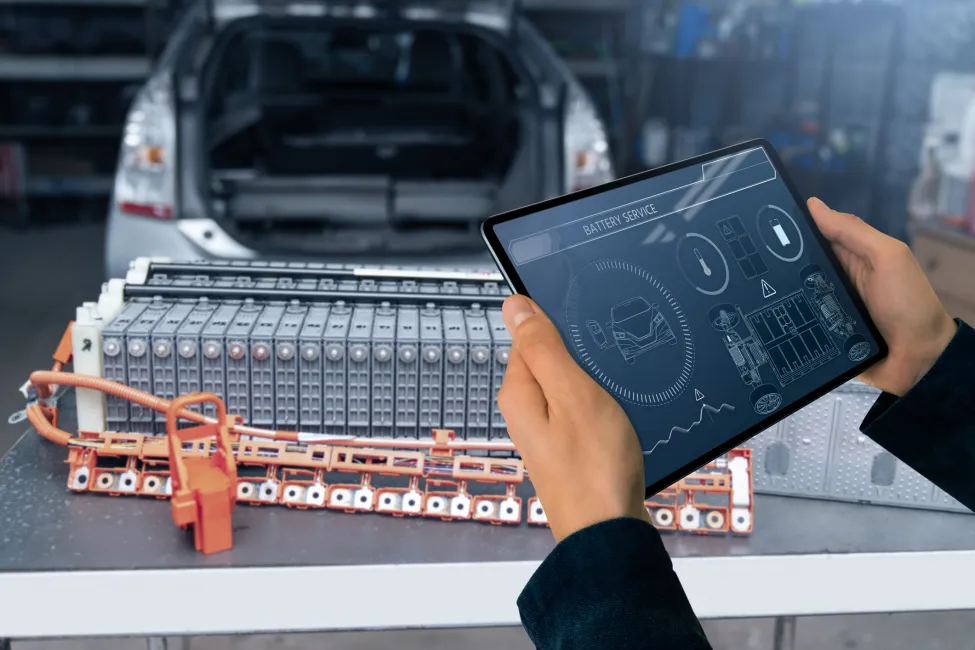
Digital twins have the potential to inform every stage of the battery lifecycle — from design qualification to product launch to postmarket surveillance to next-generation iterations. They can also be used to generate synthetic datasets and simulate edge cases that would be difficult or costly to reproduce experimentally, helping train and validate reduced-order models used in advanced battery management systems.
Predictive maintenance is one of the clearest pathways to improved reliability, with positive downstream impacts on potential recalls and warranty exposure. By combining real-time sensor measurements with electrochemical and thermal models, machine learning techniques, and historical fleet data, battery digital twins can help detect abnormal voltage drift, imbalance, or emerging faults at the pack or vehicle level sooner, helping operators proactively identify units that need service attention.
These capabilities may be deployed through advanced BMS control algorithms that use insights derived from digital twin development and validation. Pursuing maintenance activities based on a variety of conditions rather than timed schedules or mileage thresholds can, in turn, optimize service intervals and reduce incidents. If faults do occur, a BMS digital twin's detailed operational history could likewise accelerate root-cause analysis.
Why AI alone is not enough for reliable EV battery digital twins
AI offers high potential to identify anomalies and recognize patterns, but a digital twin is only as good as the data it ingests and the models that interpret it. To close gaps in data and algorithm performance and real-world use cases, engineering first principles and industry expertise are essential components of an effective digital battery twin. Without real-world constraints, AI models can misinterpret common operational artifacts as signs of degradation. For example, transient voltage sag during high-load acceleration or fast charging may be mistaken for capacity loss, while brief telemetry dropouts could falsely suggest cell imbalance.
AI models trained with physical constraints generate results that are both mathematically valid and physically possible.
To get accurate insights from an EV battery digital twin, OEMs can integrate physics models with operational telemetry from BMSs. This approach evaluates data streams such as voltage, current, temperature, and charging behavior against electrochemical and thermal models to identify degradation trends and distinguish normal operating conditions from early indicators of failure.
Engineering guardrails also help maintain digital twin reliability as new data is introduced. These guardrails may include data input validation rules, specific analytical methods, and constraints derived from scientific principles, engineering limits, and regulatory requirements, such as:
- Limits for critical parameters, such as voltage, temperature, and charging or discharging current
- Adaptive learning protocols that allow new data into the model in a controlled manner
- Compliance with safety standards such as ISO 21448 and ISO 26262 — for example, respecting minimum intervention times established during hazard and risk analysis
- Experimental and material characterization techniques to determine key physical parameters (e.g., open-circuit voltage relationships, diffusivity, conductivity) that inform both high-fidelity digital twin models and reduced-order BMS models across different battery life stages
As battery systems become increasingly instrumented, large volumes of operational data are generated across fleets. AI and machine learning techniques can help extract patterns, detect anomalies, and identify signals that may not be apparent through physics-based modeling alone. However, AI represents a complementary capability that is distinct from both digital twin development and advanced BMS design. AI is most effective when integrated with physics-based understanding and engineering constraints.
AI models trained with physical constraints generate results that are both mathematically valid and physically possible. As some outlier signals represent true precursors to failure rather than noise, physics-based domain expertise can inform outlier‑handling processes that avoid filtering out early warning signals. AI can also suffer from legacy system integration challenges, such as incompatible data formats. Efforts to clean, align, validate, and govern the data can be more expensive than developing the AI model itself.
Such diverse challenges can be addressed through a holistic approach that includes real-world expertise from several battery-related disciplines, ranging from thermal sciences to materials and electrochemistry to computer engineering and data sciences. For EV manufacturers, a digital twin can be effective when it reflects realistic and reasonable boundary conditions — the physical, electrochemical, and thermal forces and dynamics acting on the battery and the operational limits within which predictions remain valid. Since degradation pathways and failure precursors arise from multiple interacting mechanisms, multidisciplinary inputs can define the parameters that keep the model more trustworthy. Key processes may include:
- Multi-physics modeling and simulation that capture electrochemical reactions, aging processes, heat generation and management, and the effects of internal and external mechanical stresses that influence battery performance over time.
- Model calibration using manufacturing and operational data, including supply chain parameters, inline and end-of-line test results, and sensor data collected across different operating scenarios such as varying ambient conditions, charging and discharging rates, and induced fault conditions.
- Development of model-based virtual sensors to estimate internal battery states that are difficult or impractical to measure directly with physical sensors, reducing additional hardware complexity while improving diagnostic visibility.
- Prescriptive maintenance and operational optimization, enabling proactive notifications to operators or service teams, adaptive charging and discharging protocols, improved thermal management strategies, and earlier detection of conditions that could lead to failure.
Together, these multidisciplinary contributions establish the foundational guardrails that help digital twin predictions remain physically meaningful and operationally supportable. They also support the development of advanced BMS algorithms by translating high-fidelity insights into deployable control strategies. By anchoring battery digital twin performance in the physics, materials, and use patterns of real-world vehicles, EV manufacturers can transform the BMS into a proactive tool that improves reliability, monitoring, predictive maintenance, and more.
Questions Clients Ask

What Can We Help You Solve?
With expertise spanning battery systems, electrochemistry, thermal analysis, data science, and AI-enabled modeling, Exponent's consultants bring multidisciplinary insight to the development and evaluation of battery digital twins. This combination of scientific rigor and real-world industry experience helps translate complex battery data into actionable insights for improving reliability, safety, and performance.

Battery Failure Analysis & Investigation
Comprehensive battery failure analysis to determine the root causes of failures and identify opportunities for mitigation.
Vehicle Electronics & Electrical Systems
Increase the viability of your ADAS applications with optimal design and function.
Custom Battery Testing
Custom product safety, performance, and industry certification battery testing services.
Electrical Engineering & Computer Science
Understand your most formidable performance, safety, security, and compliance challenges.
Software & Computer Systems Support
Insights and solutions for the design, development, and analysis of software prototypes, products, and platforms.

Batteries & Energy Storage
Supercharge performance, reliability, and safety across all stages of the battery and energy storage product lifecycle.
