June 15, 2026
Authors


The new bill would allocate $15 million a year for four years to combat the invasive species.
On May 20, California Senators Adam Schiff and Alex Padilla introduced the "Golden Mussel Eradication and Control Act of 2026" (S.4603) to help combat invasive golden mussels that threaten the state's waterways and water and power infrastructure. The bill is a companion to H.R. 3717, introduced by Rep. Josh Harder in 2025. If passed, S.4603 would create a task force of local and state agencies, universities, port authorities, nonprofits, and other organizations to develop strategies for limiting the detrimental effects of the mussels on California ecosystems and water supply and conveyance systems. The bill would allocate $15M per year through 2030. The initial program would launch in the Sacramento-San Joaquin Delta where the invasive mussel was first discovered in California.
A rapidly growing problem
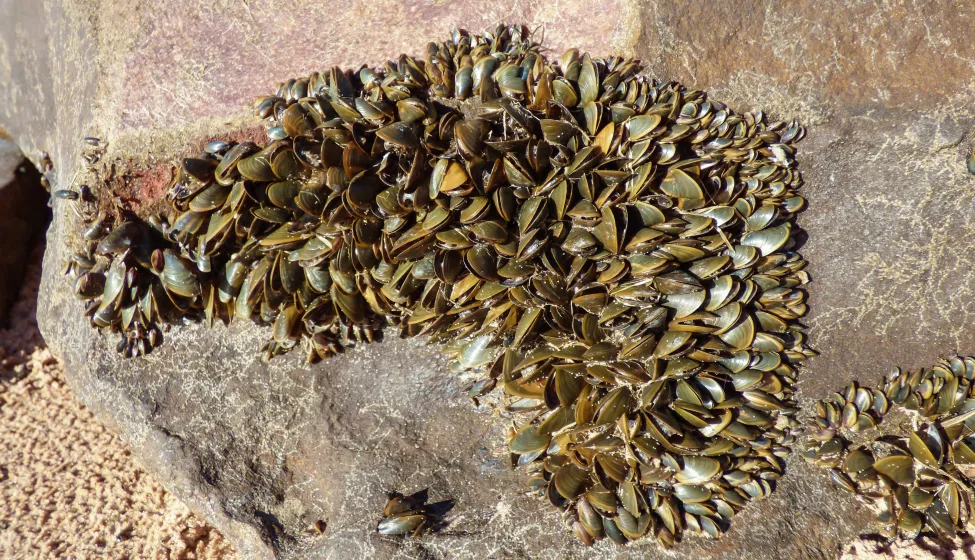
The California Department of Water Resources first found golden mussels (Limnoperna fortunei) near the Port of Stockton in October 2024. This invasive species has since spread across the state, with detections as far south as San Diego by January 2026. Warm waters and extensive, interconnected water infrastructure allow for year-round reproduction and rapid spread across the state. The California Department of Fish and Wildlife has already been working to control the spread and impacts of functionally similar invasive mussels — quagga mussels (Dreissena rostriformis bugensis) and zebra mussels (Dreissena polymorpha) — since initial detections in 2007. However, golden mussels exhibit greater tolerances to environmental conditions and treatment options than quagga and zebra mussels.
Invasive mussels are prolific breeders that when unchecked, densely colonize a wide variety of surfaces and block water flow, damage water and power facilities, reduce hydropower efficiency, and affect agriculture. Hydropower facilities in the Great Lakes region have spent millions annually on increased operations and maintenance due to quagga and zebra mussel infestations. Though functionally similar, the increased tolerance of golden mussels means more waterbodies are vulnerable to infestation over a quick timeframe in California. Further, their higher tolerance to more extreme water quality conditions and increased growth rates are anticipated to result in higher treatment costs (e.g., higher dosages and longer exposures) to protect critical water conveyance infrastructure.
A challenging response
In response to the rapid increase of golden mussels in state waters, the California Department of Fish and Wildlife has launched a campaign to educate the public, boat owners, and boat launch owners about the threat. The Golden Mussel Response Framework outlines the department's campaign, which includes an interactive map of confirmed golden mussel sightings, encouraging boaters to thoroughly clean hulls to remove golden mussels, and incentives and partnerships with boat cleaning services.
If passed, Schiff and Padilla's Golden Mussel Eradication and Control Act would allocate $15M per year through fiscal year 2030 to, according to the senators:
- Establish a demonstration program to prevent, monitor, control, eradicate, research, and educate on golden mussels;
- Track dispersal and establishment of an early warning system to alert likely areas of future infestations;
- Establish a grant program, on a competitive basis, to state and local entities, institutions of higher education, nonprofit organizations, and industry partners to carry out similar projects that control and eradicate golden mussels;
- And invest in new technology developed under the grant program.
Controlling the spread of golden mussels is extremely difficult once they have established populations, as observed in Brazil and Argentina. Mitigating impacts to hydropower facilities and water infrastructure is possible, albeit with significant expenditures and precise efforts. Current strategies for golden mussels are similar to those for quagga and zebra mussels but require higher dosages and longer exposures. Facilities can mitigate biofouling within their systems, particularly closed loop systems, through manual removal or treatment installations such as ultraviolet radiation. However, open water treatment generally requires chemicals (e.g., copper or potassium chloride), which may have undesired effects on the surrounding environment and require a stringent permitting process.
Though spreading rapidly, the golden mussel infestation is in a nascent stage, and time is a valuable commodity. State departments and water agencies are conducting early-detection monitoring, surveilling for larval forms and environmental DNA (eDNA). Potentially impacted facilities should consider initiating early-detection monitoring programs, conducting a thorough investigation of system vulnerabilities, and evaluating treatment feasibility. Such vulnerability studies and proactive measures help facilities anticipate and respond as effectively as possible to minimize impacts and avoid closures.
What Can We Help You Solve?
Exponent provides highly technical, multidisciplinary environmental expertise to help clients in industry and government protect their infrastructure from the negative impacts of invasive mussels. Our experts also provide unmatched technical guidance for complex water management challenges, helping you protect public health, the environment, service, and revenue.

Environmental Assessment & Remediation
Conduct timely, accurate site assessment to identify risks and remediation options.
Water Consulting
Exponent's multidisciplinary scientists bring decades of experience and unparalleled water resources expertise to guide complex, high-stakes decision-makin...
![[EBS] Ecological & Biological Sciences - Environmental Risk Assessment - grey heron grazing in fresh water](/sites/default/files/styles/cards_home_card/public/media/images/grey-heron-2022-01-04-23-54-37-utc%281%29_0.jpg.webp?itok=5EB0lXjA)
Environmental Risk Assessment
Risk assessments for legacy spills and contamination, potential project and product impacts, and environmental remediation support.

Environmental Causal Analysis
Identify and evaluate candidate causes of alleged or observed environmental changes.

Sustainability & Climate Change
Scientific and engineering insights to improve and quantify sustainability practices and secure vital resources and assets.

Environmental & Regulatory Compliance
Rigorous analyses to help clients overcome complex environmental and regulatory hurdles and meet auditing obligations.