
August 14, 2026
Authors





Executive Summary
FDA policy updates have created new opportunities to bring digital health wearable and digital health technology features to market more quickly. Certain functions, particularly those positioned as general wellness, may fall outside traditional medical device oversight, giving companies greater flexibility in how products and features are introduced and expanded over time. These opportunities also place greater emphasis on early decisions about intended use, validation, supporting evidence, product positioning, and claims. By making decisions early in the development process, teams can support future clinical or regulated applications with less risk, rework, and fewer uncertainties.
Four considerations for moving quickly while strengthening validation, claims, and consumer trust in wearable products for digital health
Wearable technologies continue to evolve as companies compete to deliver increasingly sophisticated digital health and wellness capabilities. FDA policy updates have brought greater clarity around which wearable functions are subject to FDA regulation. Certain features, particularly those positioned as general wellness, may fall outside traditional medical device regulation, creating opportunities to bring new features to market more quickly.
In today's wearables market, shipping fast is only half the battle. As competition increases, users expect health metrics they can trust — and when a device doesn't perform as expected, app-store reviews, social media, and high-profile critiques can quickly influence product perception. Performance and credibility have become as important to long-term success as the features wearables offer.
That opportunity comes with important strategic decisions. Because FDA classification is determined by a product's intended use and claims, relatively small changes in functionality, outputs, or marketing language can shift a feature into a regulated device. Early decisions about validation, supporting evidence, and product positioning can influence both the initial launch and how efficiently a product can transition into future regulated applications.
Moving faster means making earlier decisions
Greater regulatory flexibility places more responsibility on developers of digital health wearables to make informed decisions about validation, intended use, claims, and product strategy. That responsibility centers on three connected areas: regulatory risk, including classification of features or claims that could trigger regulatory oversight; performance risk, where limited validation may result in inaccurate or misleading outputs; and trust risk, which can affect user adoption, clinical use, and brand credibility.
These considerations often influence one another. A feature introduced for general wellness use may later expand to support clinical applications that can be medical device claims. Products that remain in the consumer market can face similar pressures as customer expectations increase or performance claims become more sophisticated. Performance limitations that are not fully understood or clearly communicated may also contribute to user dissatisfaction and increased scrutiny.
Companies do not have to choose between speed and careful product development
Trust depends on context. A level of accuracy that may be appropriate for general wellness applications may not meet expectations in clinical or performance-driven settings. Independent reviews, user feedback, and clinical experience can quickly shape product perception. Understanding these differences helps inform performance targets, validation strategies, and product positioning throughout development.
4Cs to consider for moving fast without increasing risk
Companies do not have to choose between speed and careful product development. Four areas deserve particular attention early in development. We introduce a framework to speed digital health wearable development anchored in 4Cs: Classify, Calibrate, Confirm, and Communicate.
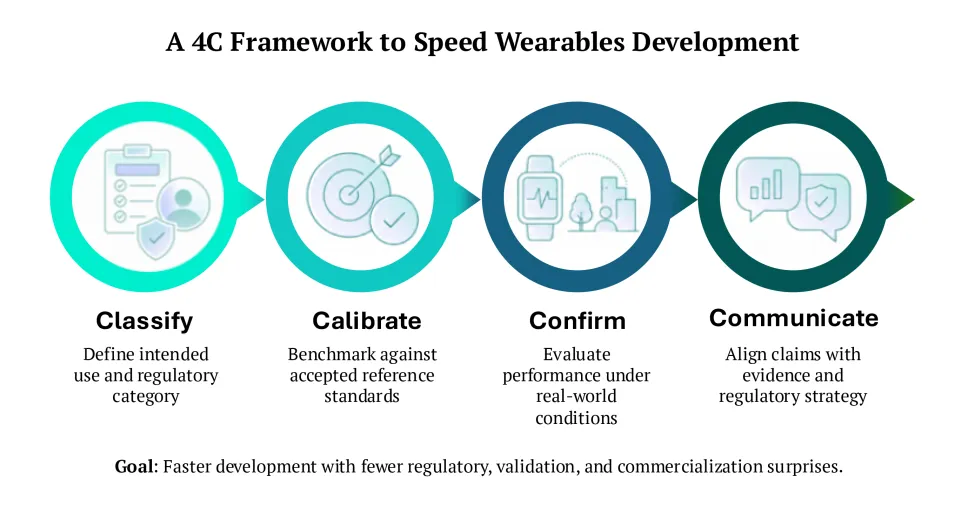
- Classify: Define the intended use of each feature early in development. Assess how functionality, outputs, and claims align with regulatory definitions. For example, trend-based insights such as "Your heart rate is increasing" may remain within general wellness, while quantitative values tied to diagnosis or treatment thresholds may be regulated as a medical device functionality.
- Calibrate: Benchmark performance against accepted reference methods where available. Established methods and performance thresholds can provide useful baselines for many physiological and behavioral metrics. Heart rate may be compared with electrocardiogram measurements, sleep staging with polysomnography, and activity tracking with validated motion-capture methods or metabolic measures.
- Confirm: Assess performance in realistic conditions. Data collected in controlled environments may not capture variability associated with user behavior, device placement, motion during exercise, ambient temperature, skin tone, or how consistently a device is worn.
- Communicate: Align claims and marketing language with available evidence and the company's regulatory strategy. Statements that imply diagnosis, treatment, or medical-grade performance may result in a product being classified as a regulated medical device. Coordination among regulatory, product, technical, and marketing teams can help keep external communications consistent with intended use and available evidence.
Together, the 4Cs framework can support product performance, clear positioning, and well-supported claims. Addressing these areas early may also reduce rework, risk, and preserve flexibility as products, customer expectations, and regulatory classifications change.
Planning for products that evolve
Many digital health wearables are designed with future expansion in mind. Some begin as general wellness or performance-monitoring products before expanding into clinical applications with medical device functionality. Others remain consumer wellness products while adding features, refining algorithms, and making more sophisticated performance claims. Whichever path a company takes, early development decisions can influence future flexibility.
Planning for that evolution introduces important considerations for validation, product positioning, evidence generation, and quality planning. Some companies intentionally sequence feature development, introducing lower-risk functionality first while building toward more advanced capabilities or future regulatory pathways. Others may never intend to pursue medical device applications but still need confidence that today's design decisions can support future product updates, evolving customer expectations, or changes in the regulatory environment.
Wearable development programs naturally prioritize innovation, user experience, and speed to market. Validation strategies, documentation, and claims often mature alongside the product. When intended use, supporting evidence, product positioning, and quality planning are considered only after key design, architecture, or data-collection decisions have been made, existing studies or product designs may not support later objectives.
Organizations considering a future medical device pathway have additional reasons to plan early. Medical device-level documentation, data integrity controls, risk management practices, and quality systems can be challenging and resource-intensive to build retrospectively. Establishing appropriate elements of a quality management system, verification and validation practices, and risk management processes during development can support a more efficient transition and reduce rework. Similar planning can benefit products that remain in the consumer market by supporting performance, strengthening evidence, and preserving flexibility as products progress through new features.
Speed and careful development can work together
Faster market entry and careful product development are not competing goals. Classifying intended use, calibrating performance, confirming results under realistic conditions, and communicating well-supported claims can help companies earn user trust while preserving future options. Decisions made early can support today's product without limiting where it may go next.
What Clients are Talking About

What Can We Help You Solve?
Exponent helps digital health and wearable developers define and execute validation strategies, design and conduct performance studies, collect and analyze data at scale, and align claims with supporting evidence, helping organizations make informed development decisions for consumer and medical device applications.
![User Research & Testing [HF]](/sites/default/files/styles/cards_home_card/public/media/images/GettyImages-1338374024.jpg.webp?itok=bBXBoCIg)
Medical Device Usability Testing
Extensive human factors evaluations for medical device manufacturers in developing and navigating regulatory roadmaps.

Decentralized Clinical Trials Consulting
Fit-for-purpose digital technology evaluations, remote monitoring, and bespoke end-to-end deployment support.

Digital Health
Fit-for-purpose digital health consulting services

Regulatory Compliance for Medical Products
Experienced regulatory support for medical devices, pharmaceuticals, and combination products.

Medical Device Evaluations
Sophisticated medical device evaluations for a vast array of applications.

Medical Device Design & Development Support
Crucial medical device design and development analyses to empower your decision-making.

Real-World Evidence Consulting
Leverage real-world data to improve healthcare decisions.
