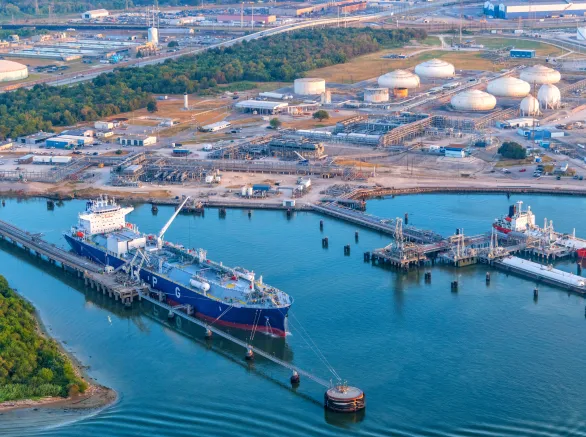

Efficient, compliant production
Consumer demands and regulation are driving rapid formulation changes for oil and gas, often requiring more complex and more maintenance-intensive equipment to refine raw materials. This equipment produces a wider variety of end products but also introduces new risks. When equipment fails, the stakes are high, from costly shutdowns to potential injuries or environmental damages.
Get to the root of failures
Exponent has decades of experience working with refineries to both determine the cause of equipment and piping failures and help refine maintenance schedules and procedures. Our multidisciplinary teams of engineers, scientists, and industry experts evaluate refinery equipment and materials failures, assess environmental damage from unintended releases, and perform rigorous worker safety assessments. We provide on-site materials and equipment evaluations and analysis of failed components in our state-of-the-art labs.
Rapid environmental response
Our environmental experts can assess the effects of unintended releases related to refining, working in concert with our human health specialists to determine impacts to nearby communities. We also work with refinery clients to rapidly respond to the U.S. Department of Transportation's Pipeline and Hazardous Materials Safety Administration (PHMSA) and the Environmental Protection Agency (EPA).
Our environmental and ecological regulatory experts can assist with wastewater compliance, help respond to state and federal Clean Water Act requirements, assist with National Pollutant Discharge Elimination System (NPDES) pretreatment permitting, and support natural resource damage assessment. Lastly, our environmental team can perform carbon footprint and lifecycle assessments for many oil and gas products.
Capabilities
Our Capabilities Are Unparalleled
Our experts provide a wide variety of services for refining, including failure analysis, environmental impact and remediation assessment, human health assessments, safety assessments, and more.
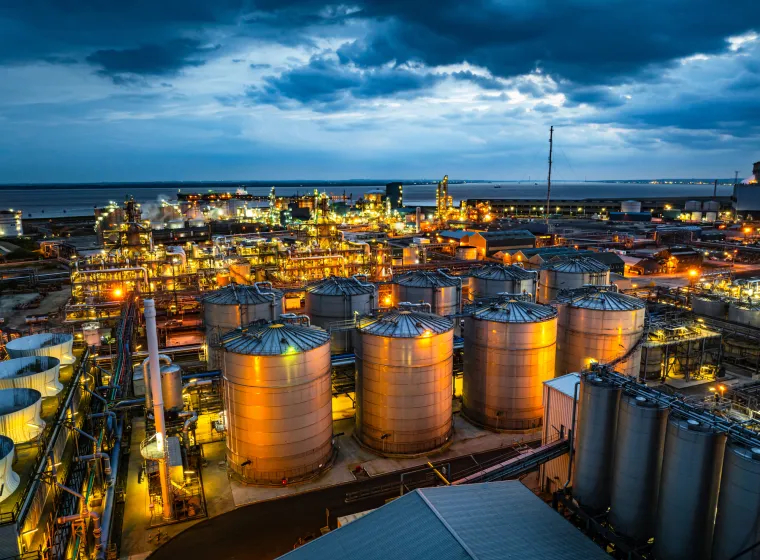
Oil & Gas Consulting
Address engineering, compliance, and safety challenges across upstream, midstream, and downstream operations.
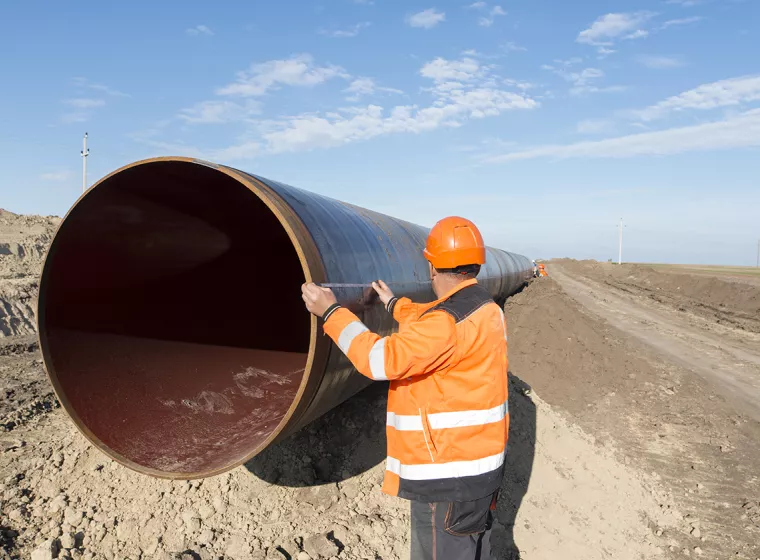
Materials & Corrosion Expertise for Pipelines and Process Piping
Minimize pipeline and piping failures with integrity and pipeline risk assessments.

Thermal Sciences Expertise for Energy Systems
Energy systems design, safety, and compliance consulting across a range of industries, including oil and gas, renewable and utility power generation.

Oil Spill Assessment
Emergency response, spill, and natural resource damage assessments leveraging sophisticated geospatial analysis and environmental monitoring capabilities.
![Computational Modeling [TS]](/sites/default/files/styles/cards_home_card/public/media/images/GettyImages-182174791.jpg.webp?itok=kmskqW9J)
Computational Modeling; Thermal Sciences
A less expensive and faster alternative to thermal or flow experiments.

Natural Resource Damage Assessment
Multidisciplinary natural resource damage assessments (NRDAs) to support navigating complex interactions with federal, state, and tribal trustees.


Expertise Within Reach
Houston is our hub for the oil and gas industry. With experts across multiple disciplines, including Mechanical Engineering, Construction Consulting, Thermal Sciences, and Metallurgical & Corrosion Engineering, we can help you face today's biggest energy challenges.
![MATERIALS AND CORROSION CAPABILITIES [MCE]](/sites/default/files/styles/fifty_media_large/public/media/images/GettyImages-157375660.jpg.webp?itok=xQrR7SvY)
Evidence You Can Act On
Exponent's labs go beyond commodity testing. We combine first‑principles engineering, real‑world data, and custom experiments to show what truly happens when equipment, materials, and industrial products meet the laws of physics — delivering multidisciplinary insights that give you clarity and confidence for high‑stakes decisions.






Relevant Right Now
How are geopolitical factors affecting downstream operations?
Geopolitical tensions are changing gas supply patterns, driving price volatility, and challenging long-term planning for downstream operators around the world. Shifts in pipeline flows, increasing demand for LNG, and evolving energy security and climate policies create uncertainty around feedstock availability, infrastructure needs, and regulatory exposure. Assessing how changing supply and operating conditions affect the integrity and performance of your facilities and equipment is essential in today's environment. This includes evaluating risks to critical assets and developing contingency planning. Exponent provides the technical insight you need to operate safely, adapt to disruptive events, and protect margins in an increasingly unstable market.
How can downstream stakeholders optimize operational efficiency while managing aging infrastructure and increasing environmental compliance?
Aging infrastructure, unexpected failures, and compliance costs are squeezing margins for downstream oil and gas entities. Having a strong grasp on asset health and lifespan to confirm its true remaining useful life is critical to avoiding premature retirement or downtime. Identifying operational vulnerabilities and inefficiencies before they impact production can help you optimize performance without major capital investment. When failures occur, rapid investigation can determine root causes and help you calculate losses, preventing costly recurrence. This approach — combining fitness-for-service assessments and responsive failure analysis — can help you maximize value while managing regulatory risk.
After a release or failure, what technical analyses matter most for regulatory response and determining impact?
Responding effectively to releases or incidents that may impact the environment increasingly requires integrating fate-and-transport with toxicology — defining how a particular oil and gas constituent moved and transformed through a given medium and its exposure and potential toxicity to ecological receptors.
In parallel, teams often need to engage with PHMSA, EPA, NOAA, USFWS, and state and tribal entities to address compliance frameworks including the Clean Water Act, NPDES pretreatment permitting, and related federal/state requirements. Where applicable, technical strategy may also include NRDA planning and documentation to support remediation/restoration decisions and communication with regulators.
Experts
Our global and comprehensive expertise across industries gives us a deep understanding of current challenges, best industry practices, and the implications of emerging technologies.

Group Vice President and Principal Engineer

Group Vice President and Principal Engineer

Corporate Vice President and Principal Engineer

Practice Director and Principal Engineer



Practice Director and Principal Scientist


Office Director and Principal Scientist


Office Director and Principal Engineer



























Senior Managing Engineer






Senior Managing Engineer

Senior Managing Engineer













Insights